
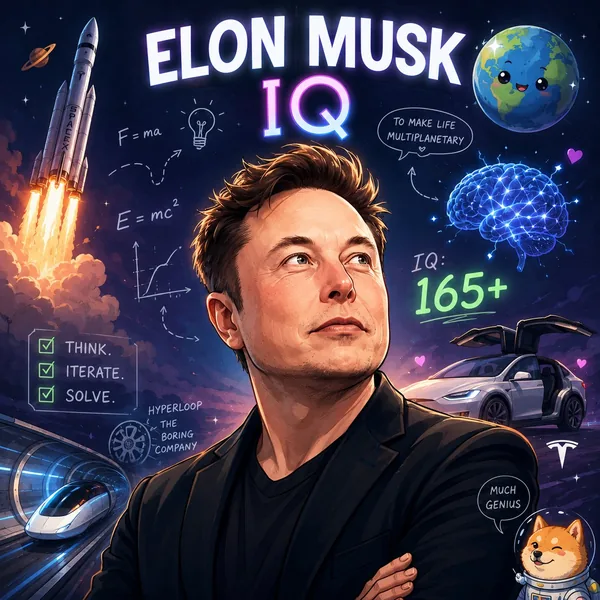
The Elon Musk IQ question — what's actually known
Search "Elon Musk IQ" and you'll find figures ranging from 130 to 160, with some sites confidently citing 155. None of these numbers come from a verified IQ test. Musk has never published, mentioned, or referenced an IQ score in any interview, biography, or public statement.
The estimates that circulate fall into three categories:
- Pop-culture guesses based on his career achievements (founding multiple billion-dollar companies, working across SpaceX rocketry, Tesla automotive engineering, Neuralink neuroscience)
- Retrospective inference by online communities — applying rough mappings between observed achievement and presumed cognitive ability
- Fabricated "leaked test results" circulating on social media, none of which has any verifiable source
For comparison, retrospective IQ estimates of historical figures like Albert Einstein are similarly unreliable — the practice of estimating IQs of people who never took the test produces wide error bars and is taken seriously by virtually no psychometrician.
Early signs of cognitive ability
What we do know about Musk's childhood and adolescence is more useful than any single number. According to biographer Walter Isaacson (2023) and earlier accounts by Ashlee Vance (2015):
- Musk reportedly read encyclopedias and a wide range of technical books in early childhood, with stories of him reading the entire Encyclopædia Britannica as a child
- He taught himself programming around age 10–11
- At age 12, he sold a video game called "Blastar" to a magazine for approximately $500
- He attended advanced math and physics curricula in South Africa, before moving to Canada at 17
These behavioral markers — early reading, self-taught programming, early monetization of technical skills — correlate with high cognitive ability, but they are not equivalent to an IQ measurement. They suggest a profile of strong verbal-spatial intelligence, high openness to experience, and exceptional drive.
The closest psychometric analogue here is the Study of Mathematically Precocious Youth (SMPY) longitudinal cohort, which has tracked intellectually precocious youth identified before age 13 and found strong predictive validity for later professional achievement.
Education path: Penn, Stanford (briefly), and self-directed learning
Musk's formal education trajectory is well documented:
- University of Pennsylvania (1992–1997) — earned a B.S. in Physics and a B.S. in Economics (Wharton School)
- Stanford University (1995) — enrolled in a PhD program in materials science / applied physics, withdrew after approximately two days to start Zip2
Admission to Penn at the time required strong SAT scores (typically in the 1400+/1600 range), which loosely correlates with measured IQ — though the SAT-IQ correlation is not 1-to-1 and varies between studies (typically r = 0.50 to 0.70 for math + verbal SAT scores against full-scale IQ in modern norms).
The Stanford acceptance is more telling: PhD-level admissions in physics and engineering at top-5 US programs typically draw from candidates with measured cognitive ability in roughly the top 1–2% of the population — corresponding to IQ scores of about 130 or higher on the standard scale.
This doesn't prove Musk's IQ is in that range, but it establishes a defensible lower bound that's much more useful than internet-circulated specific numbers.
What his career actually reveals about cognitive domains
Career achievement is a noisy proxy for IQ, but it does suggest something about which cognitive domains are strong. Musk's portfolio implicates several:
- Quantitative / numerical reasoning — required for rocket trajectory calculations at SpaceX, financial modeling at Tesla, and physics-first reasoning that Musk has discussed publicly
- Spatial reasoning — relevant to vehicle design, factory layout, and engineering visualization
- Verbal-analytical reasoning — required for the broad reading habits and rapid synthesis across domains he's known for
- Working memory and attention — needed to manage simultaneously multiple complex companies
What career achievement doesn't measure: emotional intelligence, social judgment, decision-making under uncertainty in non-technical domains. IQ tests measure a specific slice of cognitive ability, not the broader package of skills that produce billion-dollar companies.
Why IQ ≠ genius — and the limits of the question
There's a recurring confusion in popular IQ discussion: people use "high IQ" and "genius" as synonyms, but they're not. Lewis Terman's famous longitudinal study of high-IQ children (the "Termites," beginning in 1921) followed over 1,500 children with IQs above 140 and found that — while they generally did well in life — none became Nobel laureates or transformative figures. Two future Nobel laureates (Luis Alvarez and William Shockley) actually failed to qualify for the study.
This suggests that beyond a threshold (probably around IQ 120–130), additional IQ points contribute less to creative achievement than:
- Sustained, focused effort over decades
- Domain-specific expertise
- Willingness to tolerate failure and risk
- Network and timing
- Specific personality traits (high openness, low neuroticism in certain contexts)
So even if Musk's IQ is in fact 155 or 160, that fact alone wouldn't explain his career. And if his IQ is "only" 130, that's still well within the range where extraordinary career achievement is fully possible given the other factors above.
For a deeper look at how IQ tests actually work and what they measure, see our guide on how IQ tests work.
The honest answer
The most accurate statement we can make about Elon Musk's IQ:
- It has never been publicly tested
- His admission to Penn and Stanford PhD programs suggests an IQ likely above 130 (top 2%)
- His career achievements are consistent with high cognitive ability but don't pin down a specific number
- The "155 IQ" figure that dominates search results has no verifiable source
If you're curious about your own cognitive profile, you can take a free 33-question IQ test based on the ICAR framework in about 10 minutes — far more informative than searching for celebrity IQ rumors. For broader reading on extreme IQs and what they mean (or don't), see our analysis of the highest IQs ever recorded.